Saturday, March 16, 2019

Saturday, September 29, 2018
Monday, December 5, 2016
Tuesday, November 1, 2016
Sunday, October 30, 2016
Ling Gesar, Horse Race: Ch1. གླིང་གེ་སར་སྒྲུང་། རྟ་རྒྱུག་རྒྱལ་འཇོག ལེའུ་...
Published on Jan 9, 2015
གླིང་གེ་སར་སྒྲུང་། རྟ་རྒྱུག་རྒྱལ་འཇོག ལེའུ་དང་པོ།
ལེན་མཁན། ཨ་མ་ལེ་ཡ།
The first chapter of the Royal Horse Race volume of the epic of King Gesar of Ling wherein:
Manene Karmo comes to Joru (Young Gesar) and instructs him to transform himself into a crow and trick evil King Trotung into having a horse race for the kingdom. Then Joru must retrieve the treasures of Ling and win the horse race.
Joru tells his mother, Gagmo he must go to Ling. Gagmo expresses her fears and worries. The Greater and Middle tribes of Ling exiled them to Mame, where they have subsisted on rodents and wild roots. Joru has been denied his birthright, as son of King Senglon. Joru assures her that his vision was truly from Manene Karmo and that she should not worry.
Joru transforms himself into a crow and claims to be Trotung's protector, Red Tamdrin. He instructs Trotung to invite all the citizens of Ling for a horse race, whereupon the winner will take the treasure of the kingdom, the throne of Ling and the hand of Lady Sengjam Drukmo of Ga Gyalo.
Trotung believes Joru and makes offerings to "Red Tamdrin". Trotung calls upon his wife, Karak Sayi Sertso, and informs her to prepare a feast for the guests and prepare herself to be demoted to only his lowly consort after Trotung wins Drukmo.
Sertso expresses her doubt that the vision was truly Tamdrin, instead saying that it was likely Joru attempting to trick her. Trotung scolds her and Sertso complies, preparing the feast.
Messengers are sent to the Greater, Middle, and Lesser tribes of Ling. Messengers from the Lesser tribe of Ling, from which Joru hails, decide that they must send a messenger to Joru in the wilderness, help him get his sacred horse, and call him forth for the horse race.
Recited by Amalia Rubin
ལེན་མཁན། ཨ་མ་ལེ་ཡ།
The first chapter of the Royal Horse Race volume of the epic of King Gesar of Ling wherein:
Manene Karmo comes to Joru (Young Gesar) and instructs him to transform himself into a crow and trick evil King Trotung into having a horse race for the kingdom. Then Joru must retrieve the treasures of Ling and win the horse race.
Joru tells his mother, Gagmo he must go to Ling. Gagmo expresses her fears and worries. The Greater and Middle tribes of Ling exiled them to Mame, where they have subsisted on rodents and wild roots. Joru has been denied his birthright, as son of King Senglon. Joru assures her that his vision was truly from Manene Karmo and that she should not worry.
Joru transforms himself into a crow and claims to be Trotung's protector, Red Tamdrin. He instructs Trotung to invite all the citizens of Ling for a horse race, whereupon the winner will take the treasure of the kingdom, the throne of Ling and the hand of Lady Sengjam Drukmo of Ga Gyalo.
Trotung believes Joru and makes offerings to "Red Tamdrin". Trotung calls upon his wife, Karak Sayi Sertso, and informs her to prepare a feast for the guests and prepare herself to be demoted to only his lowly consort after Trotung wins Drukmo.
Sertso expresses her doubt that the vision was truly Tamdrin, instead saying that it was likely Joru attempting to trick her. Trotung scolds her and Sertso complies, preparing the feast.
Messengers are sent to the Greater, Middle, and Lesser tribes of Ling. Messengers from the Lesser tribe of Ling, from which Joru hails, decide that they must send a messenger to Joru in the wilderness, help him get his sacred horse, and call him forth for the horse race.
Recited by Amalia Rubin
Losar 2016 Ceremonies and Sacred Gesar Dance at Shiwa Gonpa Dorje Chokho...
Published on Apr 12, 2016
Ceremonies of the Tibetan Losar 2016, entrance of Fire Monkey Year. Gesar Dance, Celebration and Ceremonies carried out at Shiwa Gonpa Dorje Chokhor Ling, in Visconde de Mauá, Rio de Janeiro, Brazil. More info on Gesar at www.psttl.com or www.guruling.org
Lingdro - Sacred Dance of King Gesar
Published on Dec 30, 2012
As part of the Commemoration of the Jamgon Kongtrul lineage, the Lingdro dance was performed at the Kagyu Monlam Stage in Bodhgaya, India. The commemoration festivities took place during the 30th Kagyu Monlam Chenmo, under the supervision of the 17th Gyalwang Karmapa, Ogyen Trinley Dorje.
Saturday, October 29, 2016
Great war between Chang and Ling (English subtitles) - part 1
Manene, the spiritual guide of the King Gesar, descends from the rainbow and predicts to Gesar that the kingdom of the Ling will face the Cannibal-Demon from northern country Chang, who is the leader of all great demons of four directions. Among heroes and yogis of all the Ling, only Tripon Paseng has the power to eliminate him. The war between Chang and Ling is however inevitable as the army of Chang will attack Ling.
Tulku Tsultrim Namgyal is the director, script writer, designer and supervisor of this wonderful new film about Ling Gesar, made in Tibet, at Golok Gabde, on July 2012, with local actors, bard singers and dancers from "Nyen Ngak Drongtso", Ling Gesar's Epical Culture Village of Mayul.
My Ling Gesar teacher, Tongnyi Dhontok Rinpoche, the President of Abroad Ling Gesar's Nyan Ngak Drongtso Association, had the great kindness to entrust me with the honour to present to you this masterpiece.
To repay this kindness of Tulku Tongnyi Dhontok, I asked my professor of Tibetan language, Chung Tsering, to translate in English, and I slightly rewrite it and made subtitles. I also insured the direct communication between my translator, Chung Tsering, and the script writer, Tulku Tsultrim Namgyal. We were also helped several times by Tulku Tongnyi Dhontok, the official consultant for this film.
Tulku Tsultrim Namgyal is the director, script writer, designer and supervisor of this wonderful new film about Ling Gesar, made in Tibet, at Golok Gabde, on July 2012, with local actors, bard singers and dancers from "Nyen Ngak Drongtso", Ling Gesar's Epical Culture Village of Mayul.
My Ling Gesar teacher, Tongnyi Dhontok Rinpoche, the President of Abroad Ling Gesar's Nyan Ngak Drongtso Association, had the great kindness to entrust me with the honour to present to you this masterpiece.
To repay this kindness of Tulku Tongnyi Dhontok, I asked my professor of Tibetan language, Chung Tsering, to translate in English, and I slightly rewrite it and made subtitles. I also insured the direct communication between my translator, Chung Tsering, and the script writer, Tulku Tsultrim Namgyal. We were also helped several times by Tulku Tongnyi Dhontok, the official consultant for this film.
"Garland of tales about the birth of Ling Gesar" (English subtitles) part 1
The family of Ling Gesar are descendent of Mukpo Dong, Choephen and his sons. You will see here how Dong Marchungma and Choepen predicted the birth of Ling Gesar.
The most amazing in this video is using of nowadays tents, clothes and customs to depict the earliest kings of the Ling. But if you watch the most ancient pictures from Tibet, you will see that clothes, tentes and utensils didn't change much in Tibet since more than thousand years.
The most amazing in this video is using of nowadays tents, clothes and customs to depict the earliest kings of the Ling. But if you watch the most ancient pictures from Tibet, you will see that clothes, tentes and utensils didn't change much in Tibet since more than thousand years.
"Garland of tales about the birth of Ling Gesar" (English subtitles) part 1

When King Gesar was a young boy, his name was Choru and he was considered by many people as a demon
since he was so powerful and turbulent  :) When he met his magic horse, he became able to tame his energy and to become the King of Ling.

Tibetan epic of King Gesar of Ling is the world longest one. Amdo version was arranged in 51 volumes, but there is hundreds of volumes more in Butanes, Mongolian and many other versions.

Dzogchen monastery in Dege practices the sacred dances of Gesar epic tradition since one century.

Guru Rinpoche, the creator of Ling Gesar's power on the earth.

Amazing weapons from Tibetan epic of the King Gesar of Ling.

I will become strong and wise, as was Ling Gesar.

Tibetan hero Nyima Woeser, who spent 6 years in prison for his engagement for the protection of Tibetan culture, yangtse Rinpoche of Tonkyab monastery and venerable Shiamba during the inaugural ceremony of Serkor association.
Sorkor Language Association, aimed to promote Tibetan language and Tibetan culture, held its inaugural ceremony, despite the condition of complete isolation of Golok region from communication with external world.
This picture reached outside miraculously this morning.

Ling Gesar's drung of offering to the sacred mountain spirit Amnye Machen. ཨ་ལ་ལ་མོ་ཨ་ལ་ལེན།། ཐ་ལ་ལ་མོ་ཐ་ལ་ལེན།། ས་འདི་འདྲ་འགོག་ཡུལ་ཕྱུག་མོ


Bard in Golok Gabde recounting the life of King Gesar of Ling.

:) When he met his magic horse, he became able to tame his energy and to become the King of Ling.Tibetan epic of King Gesar of Ling is the world longest one. Amdo version was arranged in 51 volumes, but there is hundreds of volumes more in Butanes, Mongolian and many other versions.
Dzogchen monastery in Dege practices the sacred dances of Gesar epic tradition since one century.
Guru Rinpoche, the creator of Ling Gesar's power on the earth.
Amazing weapons from Tibetan epic of the King Gesar of Ling.
I will become strong and wise, as was Ling Gesar.
Tibetan hero Nyima Woeser, who spent 6 years in prison for his engagement for the protection of Tibetan culture, yangtse Rinpoche of Tonkyab monastery and venerable Shiamba during the inaugural ceremony of Serkor association.
Sorkor Language Association, aimed to promote Tibetan language and Tibetan culture, held its inaugural ceremony, despite the condition of complete isolation of Golok region from communication with external world.
This picture reached outside miraculously this morning.
Ling Gesar's drung of offering to the sacred mountain spirit Amnye Machen. ཨ་ལ་ལ་མོ་ཨ་ལ་ལེན།། ཐ་ལ་ལ་མོ་ཐ་ལ་ལེན།། ས་འདི་འདྲ་འགོག་ཡུལ་ཕྱུག་མོ
The Queen of the Ling Kingdom, Sengcham Drugmo, is ... a monk! Tongkyab monastery, as well as some others, performs every year Gesar's story. All characters are played by monks, female characters are played by most young and cute ones.
Ling way of serving tea, unchanged and well preserved tradition in Golok, Eastern Tibet.
Bard in Golok Gabde recounting the life of King Gesar of Ling.
Monday, February 15, 2016
The earliest mention of dZi beads is thought to date back to the time of King Gesar of Ling, http://www.garudashop.com/dZi_Beads_s/26.htm
 The most desirable of all beads in Tibet and the Himalayan regions is the dZi stone (which has also been spelled gzi, zi, ghzi and tzi). We have chosen to use the spelling 'dZi' simply because it is the most widely adopted spelling today. The word dZi (Wylie: gZi) is pronounced like zee or in some regions züh and can be translated as bright, luminous or shine. The Tibetan word 'Ziji' is often translated as splendour or radiance, and it is with this connection that we can perhaps understand the word 'Zi' more fully. It is easy to recognise that some people have a natural bearing of brilliance and power in the world and so in this respect, the wearing of a dZi bead is likened to this quality.
 Since time immemorial they have been revered as sacred amulets that carry and bestow blessings to the wearer, and due to their rarity, they have become incredibly sought after and subsequently very valuable. They play a significant role in Tibetan culture and continue to be used in the preparation of Tibetan medicine. The deeper meaning of the word dZi points towards the amuletic power or protective qualities associated with these beads. It is these qualities that Tibetans believe can dispel all manner of negativity for the wearer and is one of the many reasons a bead may have been heirloomed within a family for many generations.
 The actual practice of decorating stone beads has been known since at least 2500 BCE in Mesopotamia, however, it is still unclear as to the 'exact' place of origin and time of manufacture of dZi beads. The earliest mention of dZi beads is thought to date back to the time of King Gesar of Ling, although actual written records of the Gesar legend probably do not exist before the 16th century. It is widely believed that King Gesar ruled in East Tibet around 1000 years ago. He is thought to have plundered countless dZi beads from Tajikstan or Persia, which were later dispersed throughout Tibet and the Himalayan regions. A recent discovery (2014) by a team of archaeologists in Ngari, Western Tibet, date a dZi bead to the 2nd century CE. The bead, along with other funerary items, was recovered from a grave and is thought to be the first bead of its type found within controlled archaeological conditions in Tibet.
It is also believed that dZi beads were used as currency in the ancient Shang Shung Kingdom of Tibet (Chögyal Namkai Norbu 2009). The capital city of this kingdom, located to the south west of Mount Kailash, was called Khyunglung or the Silver Palace of the Garuda. This was long before Buddhism was established in Tibet and Bön was the official religion. Ancient decorated agates have been discovered in many other locations that include: Iran, Afghanistan, Pakistan, Nepal, India, Ladakh, Bhutan, Burma, Cambodia, China, Malaysia, Thailand and Vietnam.

Above: The Jowo Rinpoche statue is decorated with dZi and other precious stones.
We can see that the trade of dZi and other decorated agate beads was not limited to Tibet, however, it does seem that the Himalayan regions are the most important areas for the discovery of these beads today. The fact that they are still shrouded in so much mystery only continues to fuel people's fascination and desire to own them.
Are they a gift from the Gods?
Tibetans generally believe that dZi beads are of divine origin and therefore not created by human hands. Some say they are dropped by the Gods to benefit those who have the good fortune to find them. Since they are believed to be divinely created, they are considered to be a very precious and powerful amulet. Beads can often be seen in Tibetan temples adorning the most revered statues and stupas. They are thought to bring good fortune, ward off evil, and protect the wearer from physical harm and illness. It has even been claimed by Tibetan refugees, that they protect the wearer from knife and bullet attacks! One story doing the rounds on the internet, is that a Taiwanese businessman escaped from a plane crash where there were only two survivors. He claimed that this was thanks to the dZi bead he was wearing.
Another belief is that they are the precious dung of the Garuda or Khyung bird. These droppings in the form of dZi, fall to the ground when he flies through the sky. The Garuda has special importance in the tantric teachings of Tibetan Buddhism where he is sometimes seen as a manifestation of Guru Rinpoche. In the Hindu legends, the Garuda is revered as the steed of Vishnu and is recognised throughout the Himalayas and South Asia.
In the practice of Tibetan Medicine, powdered dZi is mixed with ground gold, silver and pearl to produce medicinal pills (Tib: ril bu) with potent healing properties. There are also clear records of dZi being used in Tibetan medicine from at least the 12th century CE. Genuine dZi are also used by Tibetan Thangka painters to apply gold leaf to important paintings. It is also said that those who own a pure dZi will receive blessings directly from divine beings. A pure dZi is also believed to bring longevity, healing, good fortune, wealth and power. Tibetan people do not readily part with their dZi. In fact it is not considered favourable to sell a dZi that has been in a family for generations. This is another reason that authentic heirloom dZi are seldom seen in the marketplace.

Physical evidence shows that beads were decorated with chemical treatments. This practice was known since at least 2500 BCE in Mesopotamia and the Indus Valley. It is believed that agate was artificially darkened by applying a sugar rich solutuion to the surface. By heating the bead the sugar would caramelise and turn the bead brown. Acid treatments would burn the sugar and turn the bead black. Even the most natural looking beads may have been put through a process to enhance the crystalline banding in the stone or darken the colour.
Beads with eyes and unique designs are usually valued much higher. A flawless and unique bead can command the highest prices and they are not easy to come by. Common decorations can include zig zags, diamonds, circles, squares, waves, and stripes. Beads with an opaque dark brown to black base colour are the most sought after, along with a clearly defined and well contrasted decoration. Having said this, even very weathered dZi beads remain collectible because they are still so scarce.
 It is generally recognised that dZi that have 1, 3, 5, 7 and 9 eyes (odd numbers) are the most sought after. A bead with nine eyes is likely to be the most valuable of all dZi, however, there are always exceptions to the rule. Beads that have unique decorations or beads that are rare in size, can also be more collectible and valuable. Next we have beads that display an even number of eyes. Two eyed beads are more readily available, so they are usually more affordable. Then we have dZi that are decorated with stripes, these are called Chung or Chong dZi (although any ancient agate bead can also be known by this name). There are also tabular dZi which are known as Luk Mik (Sheep's Eye) or Ta Mik (Horse Eye), Tasso dZi (Horse tooth), Tiger dZi (oval decorated dZi with double stripes) and Phum dZi (fat grey/black decorated agates with the net or longevity design). Lastly we have the undecorated ancient agates that were traded primarily from India and Western Asia.
According to Himalayan folklore, a good place to find a dZi is near to a rock pool or hot spring. Beads are also said to be found in freshly ploughed fields. Other stories tell us that dZi were once creatures that crawled like worms. The moment they are touched by human hands they are turned to stone (complete with perforation). Tibetans even claim that cattle would mistakenly eat these creatures whilst grazing in the fields, and later give birth to them in the form of a dZi bead.
 There is also a common story that tells of a man who once saw one of these worm-like creatures. He quickly threw his hat over it in an attempt to catch it. When he removed the hat, the worm had miraculously turned into a beautiful dZi. Another legend tells us that the dZi originated from a sacred mountain in Tibet. In ancient times, a stream was said to flow down its slopes. One day an evil sorcerer cast a spell upon the mountain and the flow immediately stopped. This is said to account for why many ancient dZi display decorations, like a stream frozen in time. Many of the decorations are said to predate Buddhism and they reflect a time when people were deeply connected to the land and nature. The symbols that appear on dZi are often compared to natural elements like water, earth and sky. Some beads are said to display characteristics of animals both mythical and real -- like a dragon, garuda, turtle or tiger for example.
Although ancient beads are the most sought after, newly made dZi (see twelve eyed bead above) can still be highly collectible. Some of the rarer quality new beads also command very high prices in and outside of Asia. For a bead to be recognised as a genuine dZi, it must be made of agate. Beads made from glass, bone, plastic, wood or any other material are merely imitations.
 During the past 20 years and with the greater spread of Tibetan Buddhism, ancient dZi have now become desirable all over the world. We manage to source a small amount of these beads every year, but this is certainly not going to last forever. On our website you will find a selection of both ancient and recently created dZi. If for any reason you are not entirely satisfied with your purchase, you may return it for a full refund. We offer you a complete guarantee that our beads are of the highest quality and are authentic.
Please note that the bead you see on our website is the bead that you will receive. All of our dZi are made from genuine agate and all are suitable to be worn. We are also able to source ancient dZi from a reliable network of dZi dealers in Asia. So if you are looking for a special bead please contact us.


Monday, October 26, 2015
The Legendary Epic of King Gesar
The Legendary Epic of King Gesar
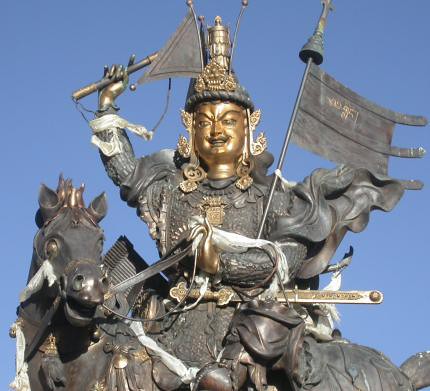 Just as the Greeks had the Iliad and the medieval Europeans had the legends of King Arthur, Tibetans had the Epic of King Gesar. The Epic of King Gesar is rooted from folklore and oral history passed down from Tibetan generations and its written origins can be traced back to 1716 when it was ordered to be translated from Tibetan by the Qing Emperor. The epic has been called the Orient’s Homeric Epic and is considered to be the longest literary work in the world. Amassing over 120 volumes and 20 million words in more than 1 million verses.
“The epic relates the heroic achievements of Gesar, the superhuman warrior ruler of the Kingdom of Ling, who waged war with the nearby Kingdom of Hor. Distinctly Tibetan in style, the epic appears to date from time of the second transmission of Buddhism to Tibet. Gesar is said to have lived without fear of his rather formidable enemies, subdued monsters, helped the poor and controlled the strong, and brought benefits to the common people”.
To Tibetans, and much of Central Asia, King Gesar is a hero. “He is said to have been born in the 11th century. During his childhood he spent his time as a shepherd and later married “Zhumao” and with her brother built an army of tens of thousands under 30 generals. After defeating their enemies, they established the State of Ling with Ozhu as its base. The Chinese acknowledge that Gesar fought in present-day Golog, Yushuo, Garze, Xinlong, Daofu, Seda, Luohuo, Aba and Qamdo. His generals were granted land in Baiyu, Dengke, Shiqu, Golog, Yushu and Qamdo”.
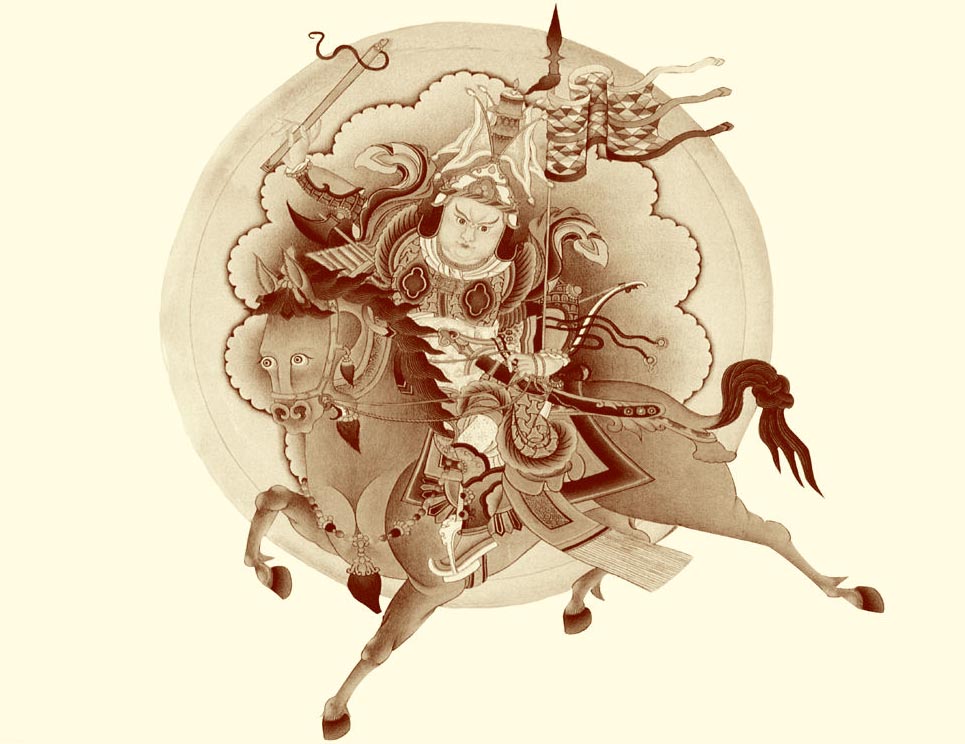 the 11th century. During his childhood he spent his time as a shepherd and later married “Zhumao” and with her brother built an army of tens of thousands under 30 generals. After defeating their enemies, they established the State of Ling with Ozhu as its base. The Chinese acknowledge that Gesar fought in present-day Golog, Yushuo, Garze, Xinlong, Daofu, Seda, Luohuo, Aba and Qamdo. His generals were granted land in Baiyu, Dengke, Shiqu, Golog, Yushu and Qamdo”.
In old age, Gesar of Ling decided to return home from Chamdo where he had been residing. Legend says that at Dengke, his horse was startled by a dog, and the king was thrown and died.
The Kingdom of Ling:
“The mythological and allegorical elements of the story defy place and time, and several places lay claim to being the former Kingdom of Ling, however both Tibetan and Chinese experts have generally agreed that the strongest claim as the birthplace of King Gesar is Axu town in the prairie of Dege County located in the Garzê Tibetan Autonomous Prefecture of southwest Sichuan Province. Gesar’s “soul mountain”, in turn, was the famous snow peak of Golog, Amnye Machen, in modern Qinghai Province.”
“The legendary locale of his early activity is written Trhom, Phrom or Khrom which does indeed sound like Rome. However, in Asia the name Rum was used to refer to the eastern part of the Roman Empire, ie. Byzantium or Anatolia. Ling is an abbreviation of dzam-ling ( Skt. Jambudvipa) which is the name for our world.
“The mythological and allegorical elements of the story defy place and time, and several places lay claim to being the former Kingdom of Ling, however both Tibetan and Chinese experts have generally agreed that the strongest claim as the birthplace of King Gesar is Axu town in the prairie of Dege County located in the Garzê Tibetan Autonomous Prefecture of southwest Sichuan Province. Gesar’s “soul mountain”, in turn, was the famous snow
 peak of Golog, Amnye Machen, in modern Qinghai Province.”
“The legendary locale of his early activity is written Trhom, Phrom or Khrom which does indeed sound like Rome. However, in Asia the name Rum was used to refer to the eastern part of the Roman Empire, ie. Byzantium or Anatolia. Ling is an abbreviation of dzam-ling ( Skt. Jambudvipa) which is the name for our world.
Tibetan tradition suggests that the upper reaches of the Yarlung River in the county of Dege in Kartse, East Tibet (now western Chinese province of Sichuan) was the birthplace of Gesar. De-ge is Tibetan for “benevolent area.” That region is full of traces linking it to King Gesar”.
Varying narratives:
“The Gesar legends vary according to the cultural tradition of the devotee. In the Bon tradition, Gesar is sent by Shenlha Okar. A Mongolian reference links Gesar and Shakyamuni. For some other Buddhists, he is an emissary of the Wisdom Kings of Shambhala, and for many Nyingmapas he is considered an emanation of Padmasambhava. Or was he the eldest of 15 sons “of Heavenly King Baifan,” according to the reporter of China Daily.
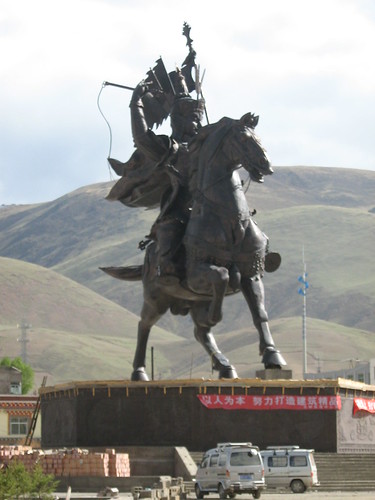
Some hold that Gesar was from Jisuya. He was born into a poor herder’s family and it was said a rainbow bridged a sky of fluffy clouds the day his mother, Gorsa, who was working in the fields at the time, felt the pangs of birth. She managed to make it up a large flat rock where her footprints are seen to this day.
Other legends say he was born in the border area of Yushu and Garze. People there describe his birthplace as: to the left of a cypress tree in a place resembling a horse’s tail; to the left of a bowl-like spring lying beneath a rock resembling an arrow.
“In a surprising coincidence,” says the Chinese article, the place at the confluence of two rivers where Gesar’s mother put up her yak hair tent, is amid the ruins of what is known as the Sutra Hall of King Gesar. Behind the ruins is a rock that indeed resembles an arrow. Local history says that the temple was built during the reign of Emperor Daoguang of the Qing Dynasty (1644-1911).
Others insist it was built much earlier, during the Song Dynasty (960-1279) by Ling Gesgyia, offspring of Wonbo Nganu Huasang, one the four brave generals of King Gesar. Family records of the Mobudong clan and headman, Ling Chang, say that this was the family temple”.
Historical remains:
 “Before the depredations of 1951 and the horrific “cultural revolution” which endured for over 10 years (beginning 1966,) the temple housed Gesar’s ivory seal, the family records of Gesar’s bailiff Ngan-yicha-geng, arrows used by General Nyiancha Ngadain, armour and weapons used by Gesar, some relics of Gesar’s father-in-law, a statue of Gesar’s horse, and clay figurines of Dainma, Shinba and Zhumao.”
(Pictured Above is the shield claimed to have been used by Gesar himself)
“Gone are the original frescoes depicting 30 generals of the State of Ling, 80 heroes who had distinguished themselves during the wars of pacification, 13 Buddhist guardians and the 18 consorts of Gesar. Other frescoes depicted military exploits.
Historical relevance/accuracy:
“Somba Yexei Banjor is a scholar who opinion is that Gesar was a real person who lived in the Ling area of Kham.
“His birthplace lies in Lhagyixiong, where the three rivers — Yellow, Lancang River and Jinsha River — meet.” “It was to the left of the Dege Castle … with a mirror-like lake. In the area is a square-shaped rocky mountain. In the centre is a lawn where the parents of Gesar put up a tent.” The place was called Ghinyi Maguanqi. Ren Naiqiang did a 1929 survey of the Kham area in which he suggested that the area “under Headman Ling Chang in the Yarlung River Valley was called Xiongba.”
Gesar’s heirs claim descent through Ling Chang. “Gesar was born in the Chacha Temple,” Ren wrote. “After his birth, grass and flowers thrived in the area a year round. The temple houses Gesar’s weapons and an ivory seal but some of his belongings were moved by a magician lama to Xiangdana, located in Xiangqian County in Qinghai Province.”
In 1942, Li Ming, corroborated that Gesar was born in the area east of Shiqu called Xiongba that is on the western bank of the Yarlung. ”
“Whether a real person lies behind the epic hero Gesar is still debated. One of the earliest written instances of his name (as Gesar, king of Phrom) appears in a ninth-century Tibetan manuscript, and the name also appears on a coin that may refer to the king of a Central Asian kingdom in the ninth or tenth century. For most Tibetans he is an eleventh-century historical figure who ruled Ling (Tibetan, Gling), a principality in Khams, that reached its peak in the thirteenth and fourteenth centuries”.
Sources:
- http://www.khandro.net/langnlit_Gesar.htm
- http://en.wikipedia.org/wiki/Epic_of_King_Gesar
- http://www.kalachakra.org/articles/gesar.shtml
- http://www.bookrags.com/research/gesar-eorl-05/
- http://www.crosby-lundin.com/tibet/culture/folktales/gesarofling.html
- http://www.tibet.cn/tibetzt/tibet50-en/story/doc/story_815.htm
- http://www.himalayanart.org/image.cfm/473.html
- http://www.china.org.cn/ch-xizang/tibet/newbook/englishhtml/gesare.html
Links:
Posted by: Jigme32
Subscribe to:
Posts (Atom)